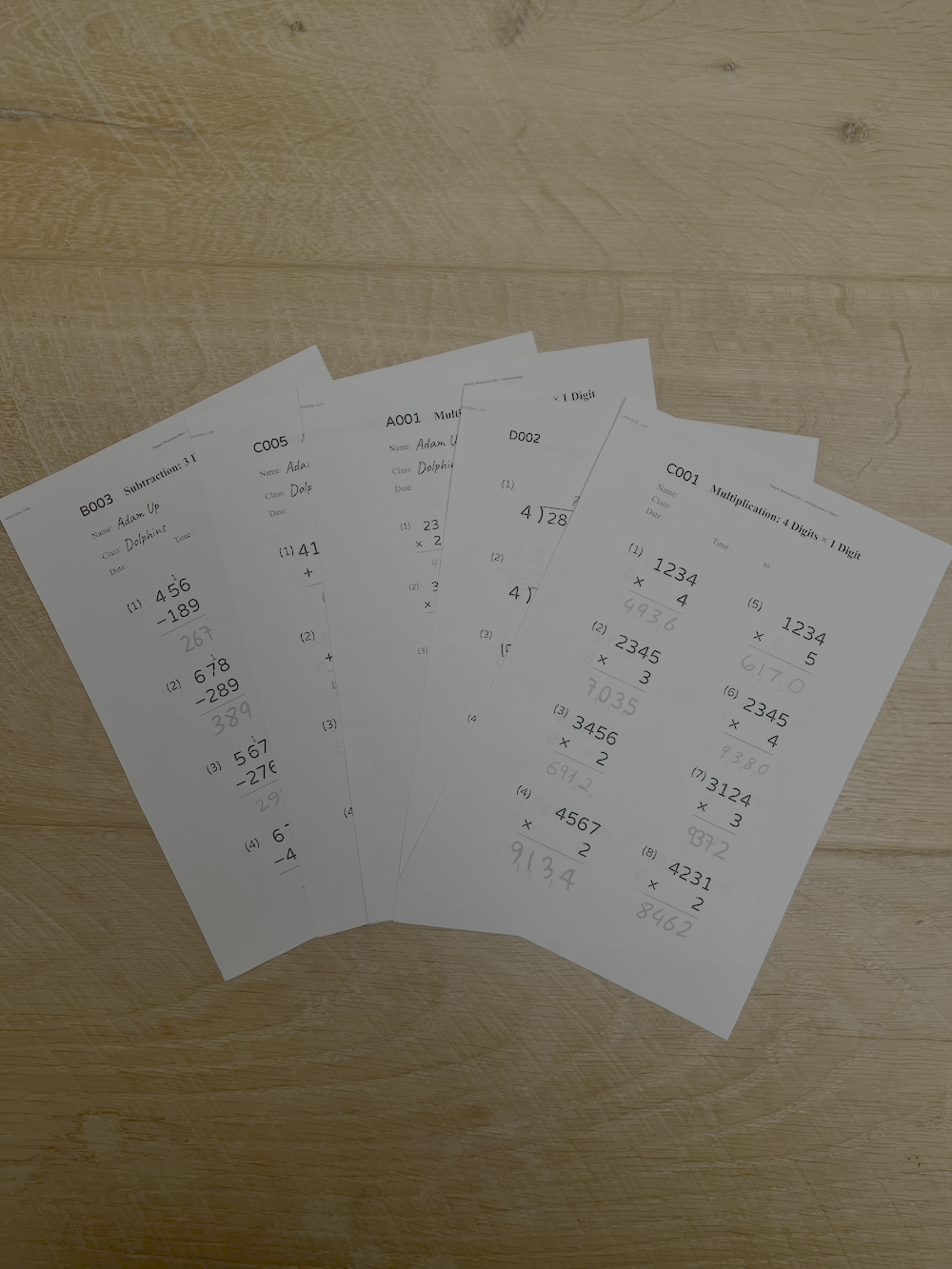
Before changing anything, it helps to be honest about where the time actually goes. In surveys across UK, Singapore and Australian tutoring centres, the single biggest surprise is always the same: most of the time isn't the marking itself, it's the admin around it. Collecting worksheets, opening to the right page, writing the date, hunting for the answer key, recording results into a progress tracker, and transferring notes into session plans. Subtract those, and the actual per-question marking is small.
That matters, because it means the biggest wins don't come from going faster. They come from cutting the steps around the marking.
Where the time actually goes
A rough but representative breakdown for one tutor group of 12 students × 40-question arithmetic drill:
- ~8 min — collecting, sorting, and organising worksheets.
- ~12 min — opening/flipping, comparing to key.
- ~20 min — ticking answers, circling mistakes.
- ~15 min — writing comments and "next steps".
- ~10 min — transferring scores into your centre tracker.
That's close to an hour for a single group, for a single session's drill work. Multiply that across tutors and session blocks, and it's why "just one more stack to mark" eats the gap between tutor rounds.
1. Mark as you go, not after closing
The cheapest intervention is shifting marking into the session. Most drill programmes include at least one 10–15 minute independent practice block. Walking between students with a red pen and marking while they work has three benefits:
- You see the error in context — far more diagnostic than a tick at 7 pm.
- Feedback lands while the student still remembers what they were thinking.
- By the time worksheets come in, half the marking is already done.
The classic objection is "I can't get round everyone." You don't have to. Pick a rotation, three students a session, targeted by need, and the whole group has had a live mark every month.
2. Use worksheet scanning
The biggest single leap today is OCR-based marking apps that read a photo of a worksheet and return per-question marks in under 30 seconds. For arithmetic, drill and booklet work, this turns most of that 20-minute "ticking" block into a few minutes of scanning and reviewing flagged answers.
Scanning doesn't replace professional judgement — it replaces the mechanical part of it. You still look at the flagged questions, you still decide what to do about them. You just don't spend the end of the week comparing 480 numbers to an answer key.
See how scanning fits your centre workflow
redmarker marks drill sheets in seconds so tutors spend time teaching, not ticking. Book a demo and we'll walk through your programme.
3. Standardise your answer format
Every additional convention — where the answer goes, how it's written, how units appear — multiplies the cognitive load of marking. The fix is boring but powerful:
- One place for the final answer. A box, a circled number, a margin column. Pick one, stick to it across all tutors.
- One format for units. Decide at the start of term whether you want
5 cmor5cm, and that's the only way it appears all year. - One method for corrections. A simple "purple pen, dot, correct answer" keeps your red pen marking fast and the student's corrections easy to see.
This also plays well with scanning. A clearly boxed final answer is easier for a machine to read and for tutors to spot-check on screen.
4. Batch by question, not by student
When marking worksheets by hand, the instinct is to do one student at a time, cover to cover. That's the slowest possible order, because you're reloading the whole question set into your head on every sheet.
Instead, fan the worksheets out, and mark Question 1 across all of them, then Question 2 across all of them, and so on. You stay "in" the question, the correct answer stays in your head, and your error-spotting speeds up noticeably by the fifth sheet.
Bonus: it surfaces group-wide misconceptions in real time. If eight of 12 students got Q4 wrong the same way, you know before you've turned a single page what the next session's starter is.
5. Replace written comments with codes
Many centres have moved away from long written comments, but some versions of "formative feedback" still require sentences on worksheets. The middle ground that keeps the formative spirit without the workload is a small, shared code system across your tutor team. For example:
CM— careful mistake (right method, wrong arithmetic).M?— method unclear, show working next time.→— try again, I've corrected the first step for you.★— stretch question for next session.
Codes are instant to write, instant to read, and — crucially — they travel: a cover tutor or a centre manager can both interpret them the same way.
Three to five codes is the sweet spot. Past that, students (and tutors) stop remembering what they mean, and they become just as slow as sentences.
6. Make "next step" the feedback
The research on feedback is consistent: students respond to what they do next, not to praise for what they've already done. If your marking ends at "well done" you've spent time writing something with almost no learning effect.
A one-sentence version that works: highlight one question, and write the next question the student should try. Done. If the marking tool you use can generate targeted follow-up questions from the errors it found, the time cost of this drops to zero.
7. Stop marking what doesn't change practice
Last, and hardest culturally: be honest about which marks you collect that never change anything your tutors do.
- Starters and fluency drills often don't need individual marking at all — a self-mark against answers on the board is fine, and the data you care about (who's fluent, who's not) is already visible in session.
- Low-stakes independent practice can be scanned and summarised rather than marked question-by-question. You look at the group picture and the flagged students, not every tick.
- End-of-unit assessments are where the detailed per-question attention should go, because the data here genuinely drives the next unit's plan.
The point isn't to mark less because you care less. It's to spend the professional judgement on the pieces where it changes what your tutors do.
Key takeaways
- Most "marking time" is admin, not marking. Cut the admin first.
- Mark in-session where you can; scan the rest; save attention for end-of-unit work.
- Consistent conventions across tutors, not longer comments, are what actually move students' learning.
Putting it together
In centres that have layered these together — in-session marking for fluency work, scanning for drill and booklets, detailed handwritten feedback reserved for end-of-unit pieces — the average reported weekly marking time on maths drops from 7–9 staff-hours to 3–4. Same students, same coverage, better feedback quality (because the attention is now concentrated where it matters).
You don't have to adopt all seven on Monday. Pick the one that fits the gap in your current week, run it for a fortnight, and see what it changes. The goal isn't to mark faster. The goal is to free tutor time for the teaching that actually grows your centre.