Most tutoring programmes are told that students need to be "fluent" at mental maths without ever being told what fluency is or how to build it in a centre session. This piece tries to close that gap. It's written for a busy afternoon timetable, not a weekend curriculum project.
What "fluency" really means
Fluency in maths isn't the same as speed, and it isn't the same as memorisation. The National Centre for Excellence in the Teaching of Mathematics (NCETM) describes fluency as combining three things:
- Accuracy — getting the right answer consistently.
- Efficiency — using a sensible method without unnecessary steps.
- Flexibility — choosing different methods for different problems.
A student who can compute 7 × 8 = 56 instantly but can't tell you
it's also "four eights and four eights" or "seven sevens, plus seven more" is
fast, but not fluent. The goal isn't to make a human calculator. It's to
build a student who can see through a number.
Why it matters more than speed
This is the part that often surprises centre managers. Fluent students don't just do
primary-school arithmetic faster, they find secondary-school algebra
easier, because the working memory freed up by not having to "think" about
7 × 8 is the same working memory they need later to think
about a quadratic.
Put differently: fluency is not a finish line. It's infrastructure. Everything built on top of it is cheaper when it's solid underneath — which is why drill programmes that build automaticity early tend to show stronger progress later.
Evidence-led summaries — such as the EEF's mathematics guidance and the NCETM's overview of fluency — stress that knowing key facts to automaticity frees working memory for harder maths. Large-scale studies often link secure early number knowledge to later attainment; the usual explanation is cognitive load, not fixed "maths talent".
Five 10-minute routines
The single best piece of advice on centre maths practice is little and often beats long and occasional, every time. Ten minutes a session, four or five days a week, will move a student further than an agonising hour once a fortnight, and it's far, far easier to actually deliver.
The first four routines work in any tutoring session, no worksheets required. The fifth applies when your programme uses written drill practice (centre sheets, booklets, or programme printouts). It's about how tutors review that work, not about owning a particular app.
1. The 90-second warm-up
Pick eight to ten facts the student nearly knows — where they hesitate but can get there. Ask them rapid-fire, mixed order. When they're right, move on; when they hesitate, say the answer out loud and repeat the question thirty seconds later.
The goal isn't to test, it's to produce fast, correct repetitions of facts that are almost automatic. The hesitation gap is where fluency is actually built. Keep it short; stop before it gets frustrating. This works well at the start of a one-to-one slot or while a group settles in.
2. Real-world maths talk
During a session break, while setting up the next worksheet, or walking a student to the door, say a number problem out loud and ask how they'd do it. Not "what's the answer", how would they work it out.
- "If eggs come in sixes, and we need twenty-four, how many boxes?"
- "There's £1.20 left on the meter and it's 15p for five minutes. How long have we got?"
- "Your sibling is four years older. When you're 12, how old are they? When they're 40, how old are you?"
You're modelling that maths is what you do to understand a situation, not the thing you do inside a booklet. That shift alone — from "maths is a worksheet" to "maths is a tool" — changes how students relate to the subject, and it's something tutors can do in seconds without extra prep.
3. "Two plus one" times tables
If a student is working on times tables, pick the two they're least confident on, plus one they already know. Mix all three together in the practice session. The "easy" one gives quick wins and keeps momentum; the two weaker ones get the attention they need without feeling like a drill camp.
Rotate every few days. Avoid the classic mistake of "learning the 7s this week, the 8s next week". Isolated blocks don't interleave, and interleaving is what makes the facts stick — a principle any centre running daily drills should build into its programme design.
Spend session time teaching, not marking
When there's written drill work in your programme, redmarker ticks the routine answers in seconds so tutors focus on the few questions that actually need a conversation.
4. The weekly mini-review
Once a week, for five minutes at the end of a session, ask the student to pick one thing they found tricky that week and talk you through it. No red pen. No worksheet. Just explaining.
The act of explaining is one of the most powerful learning tools we know — it forces them to organise the knowledge they already have, and it surfaces the gap you want to close. It also tells you what to pay attention to over the next few sessions, without needing to set anything extra.
5. Marking drill sheets together
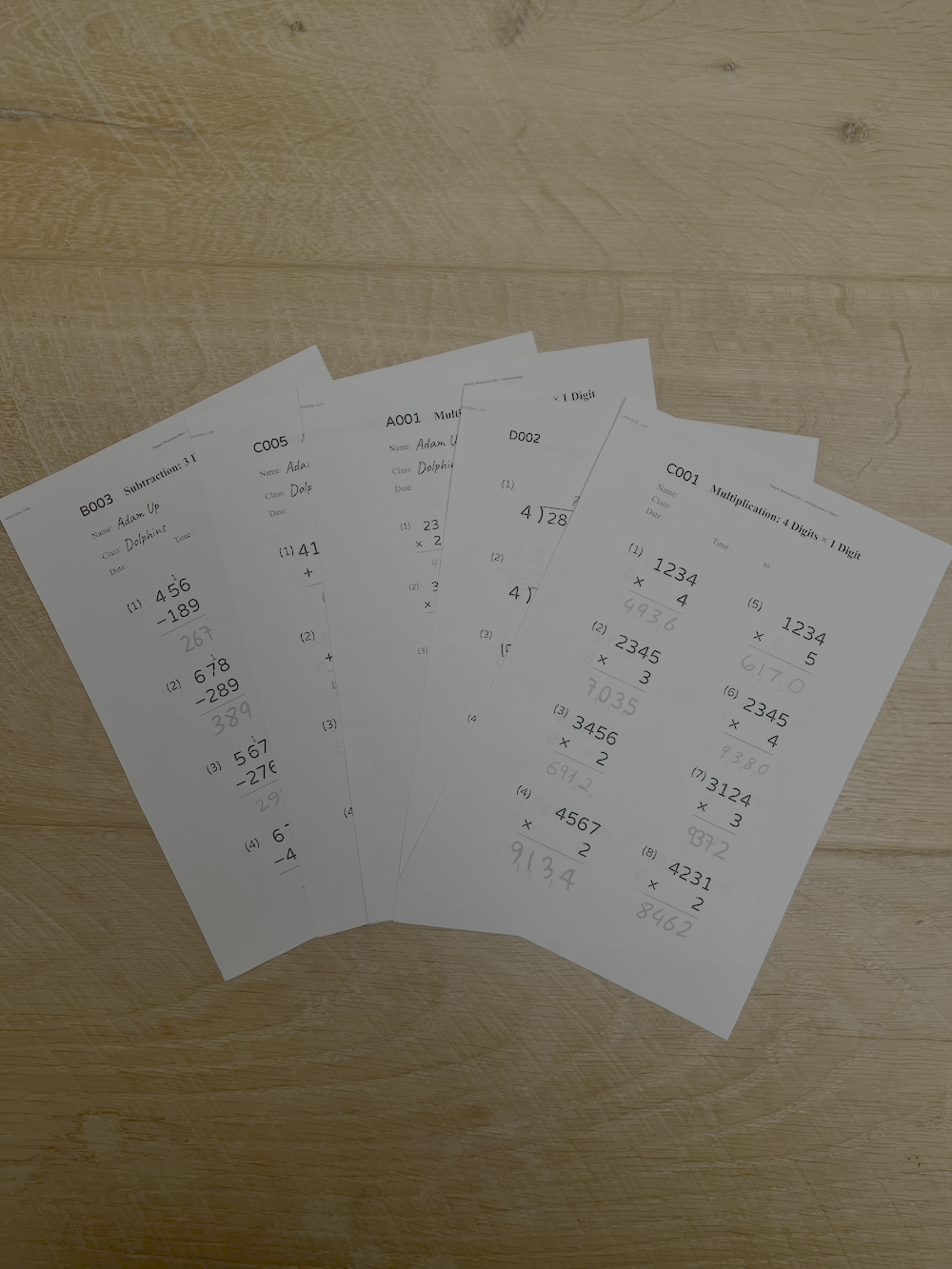
If your programme uses written maths — centre drill sheets, a workbook page, or a sheet from your curriculum — sit with the student while you go through it. Keep it short, calm, and focused on how they reached an answer, not on the total score. You can tick and talk it through with a pencil like anyone would; that's the core habit. Worksheet scanning only saves time on the mechanical part if you want it to, so tutors get to the interesting mistakes faster.
Either way, you're aiming for a handful of questions worth discussing, not a full review of every line. Those two or three, talked through properly, are where the learning happens; the rest is just confirmation.
Key takeaways
- Fluency = accuracy + efficiency + flexibility. Don't confuse it with raw speed.
- Ten minutes a session, four or five days a week, beats an hour once a fortnight.
- Interleave weak facts with strong ones; don't practise in isolated blocks.
- Talking about how to solve a problem is often more useful than solving another one.
- If you use written drill practice, spend a few minutes on method for a couple of questions. The score matters less than how they got there.
What to avoid
Three things reliably make centre maths practice worse rather than better:
- Long sessions when the student is tired. A frustrated 45 minutes does more harm than good. Five calm minutes beats it every time.
- Timed tests as a regular routine. Used occasionally, for students who enjoy them, fine. Used weekly on students who are anxious about maths, they produce the exact anxiety they were meant to measure.
- Comparing students within a group. Maths confidence is fragile. Private, incremental progress is what builds it — track against the student's own baseline, not the student at the next desk.
A last honest note
You don't need to be a maths specialist to help a student become fluent. What matters is that your centre builds ten minutes of focused practice into every session, most days, and takes the subject seriously without making it stressful.
Fluency is built in small, repeated moments. The bad news is there's no shortcut. The good news is that any well-run tutoring programme can do the thing that works.