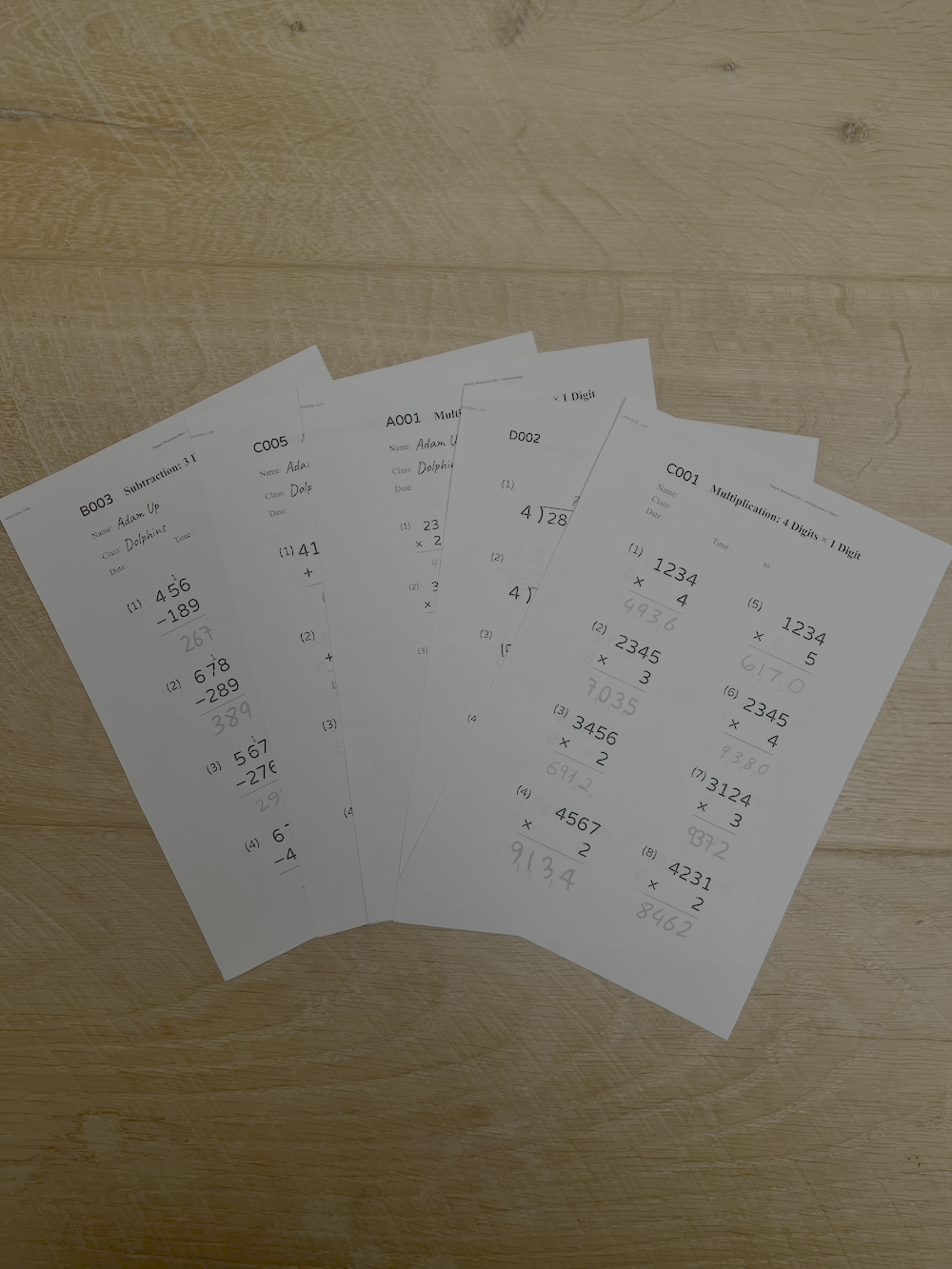
If you run a Kumon-style or daily-drill maths programme, you already know the tension: students need consistent practice, but long sessions eat tutor time and centre capacity. The good news from the research is that shorter, more frequent drills are not just adequate — they are more effective than longer blocks.
Five minutes is enough. It fits in the gap between tutor rounds, at the start of a session, or as a warm-up before one-to-one work. And when marking keeps pace, the whole loop — practise, check, correct — can happen inside a single visit.
The science bit (kept short, we promise)
In the 1880s, a German psychologist named Hermann Ebbinghaus mapped out what he called the "forgetting curve": the rate at which our brains shed new information if we don't revisit it. His finding was uncomfortable but simple: we forget most of what we learn within 24 hours if we don't see it again.
The fix isn't to study longer. It's to study again, sooner.
This is the principle behind spaced repetition: revisiting information at regular intervals to move it from short-term into long-term memory. It's the same reason a student can recall yesterday's times-table drill but not what they did three weeks ago without revision.
For primary and lower-secondary maths, this is particularly powerful. Number facts (addition bonds, times tables, subtraction) aren't concepts to be understood once and filed away. They're skills that need to be automated, so a student can recall them instantly without burning mental energy that should go towards solving the actual problem.
Short daily drills do exactly that. Long weekly sessions largely don't.
Why long sessions backfire
Sit a seven-year-old down for 45 minutes of drill work and you'll likely get one of two things: a student who switches off after ten minutes, or one who powers through but retains very little by the following week.
Cognitive load research tells us that young students' working memory is limited. Once it's full, new information simply doesn't stick; it's like trying to pour water into an already full glass. Shorter sessions mean the glass never overflows.
There's also a capacity problem for centres. Long drill blocks tie up a tutor or a desk for nearly an hour, which doesn't scale when you're running back-to-back groups. Five-minute drills fit the rhythm of a busy centre: students arrive, complete their sheet, get feedback, and move on — without the friction that makes programmes hard to sustain term after term.
What five minutes actually looks like in a centre
You don't need a bespoke curriculum overhaul. You need a standard drill sheet, a timer, and a marking workflow that doesn't create a backlog.
- Set a timer for five minutes at the start of each session (or in a dedicated drill slot between tutor rounds)
- Hand out the day's worksheet — same format, same answer-box convention, every time
- Let students work through as many questions as they can
- Stop when the timer goes, regardless of how far they've got
- Mark immediately — before the next group arrives
That's it. No marking pile at closing time. Just five minutes of focused practice, checked while it still matters.
Over days and weeks, tutors start to notice something: the questions students used to pause on, they now answer without thinking. That's automaticity forming. That's the goal of any daily drill programme.
The marking problem nobody talks about
Here's the part most programme guides skip over: the drill only works if students get feedback. A student who writes a wrong answer and never finds out it's wrong doesn't learn; they just practise the mistake.
But marking worksheets takes time — often longer than the practice itself. When a centre runs 40 daily drill sheets across multiple groups, manual marking becomes the bottleneck that breaks the spaced-repetition loop.
This is exactly the problem redmarker was built to solve. Point a phone camera at a completed worksheet and it marks it in seconds: green ticks for correct answers, red markers for errors. No sitting down with an answer sheet. No mental arithmetic on the tutor's part. Just instant, accurate feedback the student can act on before they leave the centre.
Because feedback that comes five days later, when the worksheet has been filed in a folder, isn't feedback at all.
Keep daily drills moving at centre pace
See how redmarker fits a Kumon-style or short-session drill programme — marking included.
The one thing that matters more than anything else
Consistency beats intensity every time.
Five minutes today, five minutes tomorrow, five minutes the day after. That's what builds maths confidence in a tutoring programme. Not a two-hour catch-up block on a Saturday. Not a panic push before exams. Just a small, sustainable habit built into every session visit — the kind of routine centres like Kumon, Explore Learning and independent maths programmes have known for decades.
Five minutes, marked fast, every day. That's enough.
Key takeaways
- Spaced practice: short, frequent sessions beat rare long blocks for moving facts into long-term memory.
- Cognitive load: young students hit a working-memory ceiling; shorter sessions stay under it.
- Centre routine: a timer, a standard worksheet, and immediate marking fit between tutor rounds.
- Feedback: fast checking matters; delayed marking breaks the spaced-repetition loop.